 |
 |
| |
|
|
|
| |
| |
| |
| |
| |
|
|
|
| NAGARHOLE
(Rajiv Gandhi National Park) |
| |
|
|
|
|
|
|
|
| ABOUT
NAGARHOLE |
| |
|
|
|
|
The literal translation of Nagarhole means the
Stream of the Cobra (Naga means Cobra and Hole means Stream in the
native Kannada language). Spread over a large area of around 650
sq kms, this is one of the best conserved and protected wildlife
parks in India. As a result, the park has perhaps the highest concentration
and variety of animals in the sub-continent, which is reputed to
rival the large concentrations of wildlife found in parts of Africa.
Nagarhole is truly a unique example of highly successful wildlife
protection in Asia.
|
| |
|
|
|
|
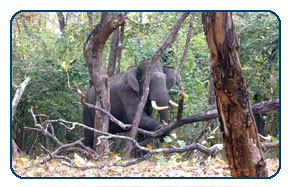
Nagarhole,
along with the Mudumalai, Bandipur and Wynad sanctuaries forms the
Nilgiri biosphere reserve that covers over 3000 sq kms of contiguous
forests. This provides vital migratory corridors and food supply
for elephants. As a result, Nagarhole has over 1500 elephants, considered
to be the largest concentration of Asian elephants on this planet.
Thanks to the strong protection to elephants provided here, one
can often sight huge, magnificent tuskers in the park. This is not
the case in other parks where the fear of poachers has made tuskers
very elusive. |
| |
|
|
|
A
number of rivers drain the Park, resulting in abundant supply of
water and vegetation throughout the year. This has led to a large
concentration of a wide variety of herbevores like deer and Indian
bison (Gaur). The availability of abundant prey, as well as space
to earmark territory, has made Nagarhole one of the key breeding
grounds for the big cats in India. Over 60 tigers and 150 leopards
reside in this Park. The other main carnivore in the park is the
Indian wild dog or Dhole, famous for its unique habit of hunting
in packs. The Park is also known for the only four horned antelope
in the world, the ‘Chousingha’. |
|
| |
|
|
|
The
Park is also a veritable store house of a large variety of reptiles
and birds, large and small. Over 250 varieties of birds are found
here, thanks to the swamps, lakes and rivers which provide breeding
habitats and food to these winged inmates of the forests. A diverse
range of reptile, lizard and insect life can also be found, including
the endangered ‘flying lizard’ and the ‘flying
snake’. The colourful Giant Indian squirrel can be quite commonly
seen. |
| |
|
|
|
| Nagarhole
is perhaps the best example of what conservation can achieve, when
managed well. But this has not been without its challenges. A major
fire in 1992, believed to have been set by disgruntled locals and
poachers, destroyed large tracts of the forest. Fortunately the
forest has since regenerated with attention from the officials.
The avoidance of similar incidents in future will mean that the
economic welfare of the locals has to be ensured, and tourism is
perhaps the best bet for this. |
| |
|
|
|
|