 |
 |
| ABOUT
MUDUMALAI |
| |
|
|
|
|
Welcome
to Mudumalai, the Masai Mara of India. As you drive into the sanctuary,
a herd of wild elephants crossing a dry river bed blocks your car.
Tiny villages dot the landscape, with their resorts and houses sporting
electrified fences to keep out marauding elephants. Your friendly
resort owner wakes you up in the middle of the night to listen to
the deep moaning calls of a tiger looking for its mate.
On a trek, you surprise a tiger taking a nap behind a bush, and
he gets up and walks away. On your lucky day you spot a leopard
lazing on a tree branch.
|
| |
|
|
|
 |
Forest guides recount hair-rising tales involving
humans and elephants (surprisingly the elephant is the most feared
animal here, not the tiger which seldom attacks people). Mudumalai
is indeed a place where every moment of your stay bristles with
the excitement of a potential encounter with wild life. In fact,
most of our wild life sightings here have happened on casual treks
and drives. To top all this, Mudumalai probably has some of the
finest infrastructure and adventure options for tourists among jungle
destinations in India. Truly, this is the Masai Mara of India.
|
| |
|
|
|
| Mudumalai
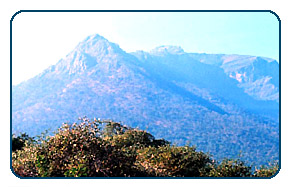
lies on the southern tip of the Western ghats, at the foot hills
of the Nilagiri hills (also known as the Blue Mountains). Along
with the Nagarhole, Bandipur and Wynad sanctuaries, it is part of
the vast Nilagiri biosphere reserve which consists of over 3000
square kilometers of protected, contiguous forests. The biosphere
provides valuable corridors for animals to migrate, crucial for
maintaining predator-prey balance, healthy breeding and optimal
utilisation of water and food resources. |
|
| |
|
|
|
Mudumalai
in the local Tamil language means “the ancient hills”.
The sanctuary occupies over 320 sq kms and lies in a large valley
consisting of vast tracts of flat rolling terrain surrounded by
hilly |
 |
slopes.
This makes the climate tropical with hot, dry summers and mildly
cool winters. The flora is mainly deciduous (dry as well as moist),
but one can see a mix of various vegetation types here – patches
of evergreen forests, swamp lands, large tracts of scrub jungle
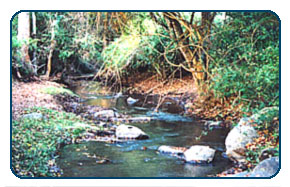
and riverine forests. Two rivers – Moyar and Sigur –
water the forests and with their numerous tributary streams and
gorges add spectacular beauty to the landscape. A number of small
tribal villages and hamlets dot the landscape, occupied by people
who have lived here for a long time along with the wild life. |
| |
|
|
|
| Mudumalai
is famous for the Asian elephant – it is the base for the
Project Elephant in the Nilgiri biosphere – and the Indian
wild bison or Gaur, both of which are very well represented numerically.
The sanctuary has about 30 tigers and 80 leopards. Mudumalai is
also famous for the Indian wild dog or Dhole, with a number of packs
present. We were once fortunate to see a large pack out on a hunt
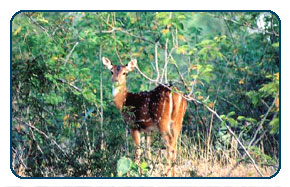
on a hill slope just before sunset. Other large animals which are
found here are sloth bear, a variety of deer, wild boar and hyena.
The sanctuary is said to have a few black panthers which are rarely
sighted. A number of smaller inhabitants like the Indian giant squirrel,
langur, porcupine, bonnet macaque, mouse deer, hare, etc can also
be sighted. Mudumalai is an ornithologist’s delight with a
large variety of birds. Large peafowl can be commonly seen, with
the males exhibiting their brilliant plumage. Reptiles abound in
the jungles, with the Indian python being the star attraction. Otters
and crocodiles can also be seen in the Moyar river. |
| |
|
|
|
If
you want a holiday where you breathe wild life every moment of your
stay, Mudumalai is the place for you. |
| |
|
|
|
|